
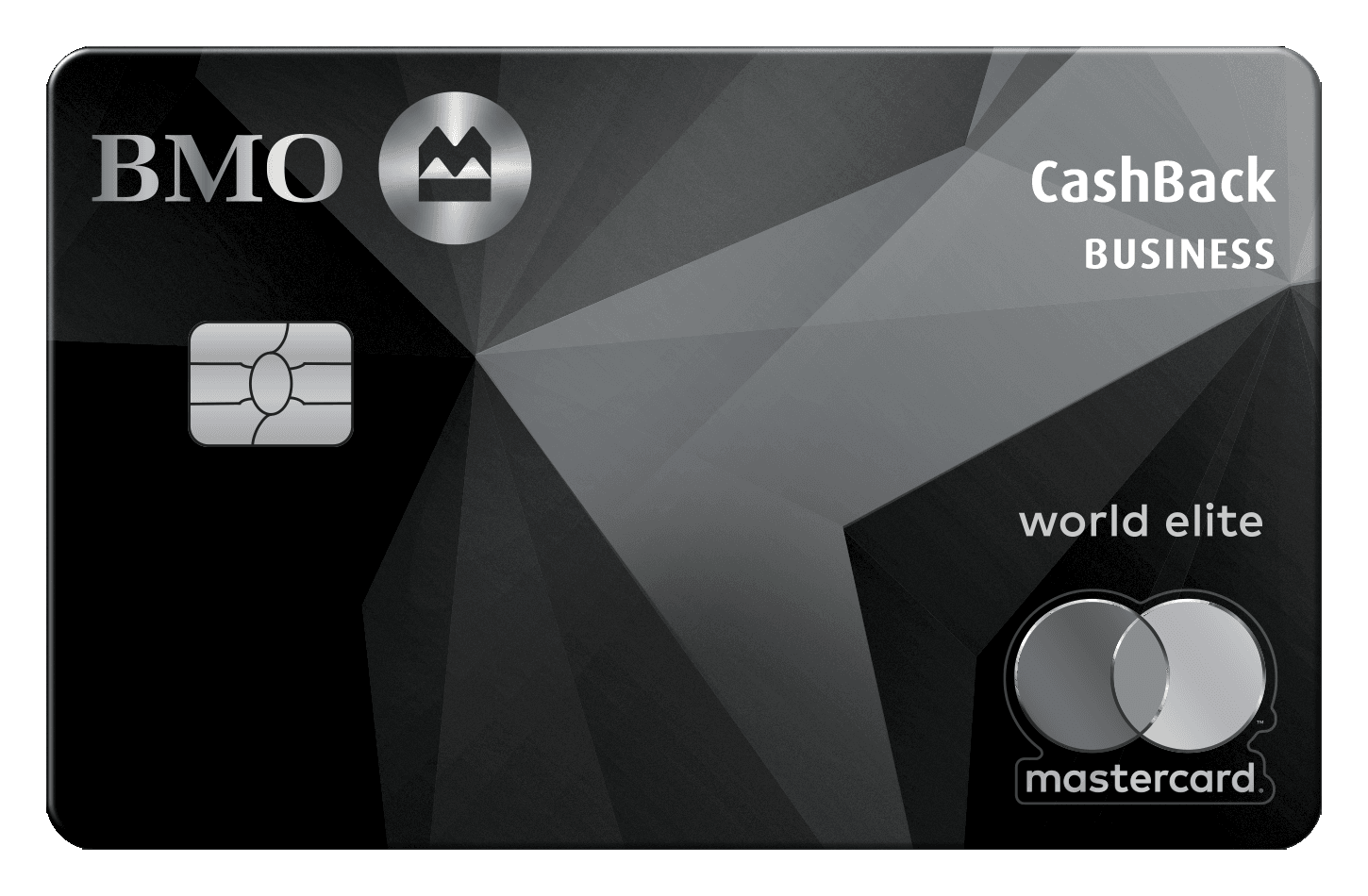
Up to $900 with the BMO CashBack World Elite Business Mastercard
BMO’s new business Mastercard offers up to $900 in welcome cash back. See how to split your spending across four caps and whether the card beats BMO’s no-fee option at renewal.
The BMO CashBack World Elite Business Mastercard® offers up to $900 in welcome cash back in the first three billing cycles. You need $6,000 in eligible purchases split across four spending groups to earn the full amount. BMO launched the card on November 9, 2026, and rebates the primary cardholder’s $175 annual fee in year one.
The decision changes at renewal. A consultant and an online retailer can put similar expenses on the card yet come out on opposite sides of the fee once the welcome rates end. The examples below use BMO’s terms as of November 9, 2026, and show what the paid card adds over BMO’s no-fee business card. All amounts are in Canadian dollars.
How the $900 offer works
BMO lists the welcome offer for applications received from November 9, 2026, to December 14, 2027. Your spending window starts when the account opens and covers the first three billing cycles. Read the offer under footnote ∆∆∆ in the BMO business card terms.
The 15% includes the card’s regular cash back on the purchases it covers. The three $500 limits apply over the entire welcome period, and the $4,500 limit has its own bucket. The unused portion of one limit cannot be moved to another.
| Eligible spending group | Spending at 15% | Maximum cash back |
|---|---|---|
| Gas and EV charging | $500 | $75 |
| Recurring bill payments | $500 | $75 |
| Shipping, insurance, office supplies, and telecom | $500 combined | $75 |
| Other purchases | $4,500 | $675 |
| Total | $6,000 | $900 |
What your first three cycles could earn
Start with purchases already in your budget. For example, if $6,000 of equipment is your only purchase and it all codes as other spending, only $4,500 earns 15%, for $675. The remaining $1,500 earns $18.75 at the regular 1.25% rate, for $693.75 in total on that purchase.
The examples below use three cycles of the spending profiles shown in the renewal section. They count only the cash back on the part of each category that gets 15%. For your own estimate, use net purchases after refunds and leave out cash advances, cash-like transactions, and fees.
A retailer that already spends $300 on fuel over those three cycles can earn $870 at the welcome rate if it fills the other three buckets. Another $200 of eligible fuel would bring that to $900. Count it only if you had already planned to buy that fuel within the window. Check your statement closing dates before moving a purchase forward.
| Business profile | Total spending in 3 cycles | Portion at 15% | Cash back at 15% |
|---|---|---|---|
| Independent consultant | $3,000 | $2,750 | $412.50 |
| Online retailer | $10,950 | $5,800 | $870.00 |
| Renovation contractor | $7,800 | $3,550 | $532.50 |
| Small design studio | $1,590 | $1,590 | $238.50 |
BMO CashBack World Elite rates
The card starts at 1.25% on eligible purchases. On the first $1,000 in each of three groups per statement cycle, BMO raises the rate. Any eligible spending above a group’s limit goes back to 1.25%, and the other groups keep their own limits. This matters if you buy in batches or receive a large annual invoice.
| Eligible spending group | Higher rate | Spending limit | Rate above limit |
|---|---|---|---|
| Gas and EV charging | 5% | $1,000 | 1.25% |
| Recurring bill payments | 4% | $1,000 | 1.25% |
| Shipping, insurance, office supplies, and telecom | 3% | $1,000 combined | 1.25% |
| Other purchases | 1.25% | Unlimited | 1.25% |
Check how merchants are classified
BMO uses Mastercard merchant category codes and Canadian merchant locations for its higher rates. An automatic software payment may earn 1.25% if its merchant code does not qualify. Office furniture bought from a general retailer may also earn the base rate even if you buy it for work.
Insurance appears in BMO’s lists for both recurring payments and the 3% business group. Assign each charge to one group in your estimate. Check how BMO rewards a small payment on your first statement before relying on the higher rate for a larger invoice.
What you keep at renewal
To compare the two cards, take 12 cycles of spending, calculate regular cash back, and subtract annual fees. The no-fee BMO CashBack Business Mastercard earns 1.5% on eligible gas, office supplies, and mobile or internet bills, with a separate $1,000 cap per category per statement cycle. It earns 0.75% on other eligible purchases and amounts above those caps. We use regular rates on both cards.
In the examples below, each profile repeats the same four spending amounts for 12 statement cycles. All balances are paid in full, and there are no employee cards or merchant surcharges. The calculation excludes welcome offers and puts no dollar value on insurance or other perks. Amounts are rounded to the nearest dollar.
For the no-fee card, we assume $100 of qualifying office or telecom spending per cycle for the consultant, $150 each for the retailer and contractor, and $50 for the studio, in addition to eligible gas. Shipping, insurance, software, and inventory earn the base rate on that card in our examples. The contractor buys gas rather than EV charging.
| Business profile | Gas or charging | Recurring bills | 3% business group | Other purchases |
|---|---|---|---|---|
| Independent consultant | $0 | $250 | $100 | $650 |
| Online retailer | $100 | $200 | $850 | $2,500 |
| Renovation contractor | $1,500 | $150 | $250 | $700 |
| Small design studio | $0 | $80 | $50 | $400 |
| Business profile | World Elite, after $175 fee | BMO no-fee | World Elite advantage |
|---|---|---|---|
| Independent consultant | $79 | $99 | −$20 |
| Online retailer | $662 | $351 | +$311 |
| Renovation contractor | $767 | $338 | +$429 |
| Small design studio | -$59 | $52 | −$111 |
Use the statement date for large bills
An online store paying $2,000 of eligible shipping in one cycle earns $42.50 on the World Elite card. Two $1,000 payments posted in separate cycles earn $60, assuming shipping is the only expense in the 3% group in those cycles. If your supplier already offers two billing dates at the same price, that is a $17.50 difference without buying anything extra.
Price out employee cards
BMO charges $75 per additional World Elite card annually. The first-year rebate applies to the primary card, and BMO prorates the first-year fee for employee cards added during that year. An employee card must bring $6,000 in new eligible spending at 1.25% to earn $75 in cash back, assuming those purchases would otherwise earn nothing. If the primary card could already capture the same purchases, compare the extra fee with the time saved and the spending controls you gain.
Set a benchmark for ordinary spending
For a business that earns the base rate on every dollar with both cards, the World Elite card adds 0.50 percentage points over the no-fee BMO card. It takes $35,000 in annual base-rate purchases to offset the $175 fee difference with one cardholder. That is the threshold for coming out even against the alternative. At $14,000 the World Elite card earns $175 before fees, while the free card still returns $105.
Fees, perks, and eligibility
BMO lists a 20.99% purchase interest rate and a 23.99% rate for cash advances. If you regularly finance inventory on a credit card, compare interest costs first. A $5,000 balance that accrues interest for 30 days at 20.99% would cost roughly $86, using a simple daily calculation before other charges.
BMO advertises up to $1,760 in first-year value. That figure includes the fee rebate and estimated values for five Maple virtual care visits, roadside assistance, and DragonPass membership. BMO includes the membership and charges separately for lounge visits. Give each perk the value of an expense it would actually replace for your business. See the BMO launch announcement.
BMO lists four ways to meet the financial eligibility requirement. You need at least one of the following, subject to approval.
- $80,000 in annual personal income.
- $150,000 in annual household income.
- $250,000 in annual business revenue.
- $400,000 in assets under management.
When the paid card makes sense
If you put fuel and shipping on a card every month, use a recent statement to estimate what the higher rates add. If you mostly charge inventory, equipment, or software that earns 1.25%, compare that extra cash back with the fee you will pay at renewal. Use the Ratesopedia card comparison tool to check another rate and fee against the same budget.
See the BMO CashBack World Elite Business card details for the current terms.

- Annual feeNo annual fee the first year
- $0 $175
- Our valuationMilesopedia first-year estimate First-year valueAnnual fee rebated$175Total$175Rewards on your spending are not included. The calculator that adds them from your own profile is on the card's page.
- $175
- Welcome offer
- Up to 15% cash back in the first three billing cycles, up to $900, on up to $6,000 in purchases allocated according to BMO’s category limits.
- Ends Dec 14, 2027
on BMO's website
Frequently asked questions
Can any $6,000 earn $900?
The full $900 takes $500 in each of the three smaller categories and $4,500 in other eligible purchases over the first three billing cycles. For instance, a consultant with no qualifying fuel or EV charging could earn up to $825 at the welcome rate by filling the other groups. Extra spending in those groups cannot replace the unused $500 fuel allowance. Compare that result with the costs and offers in our guide to business credit cards.
Do all recurring payments earn 4%?
BMO requires both automatic billing by the merchant and an eligible merchant category code for the 4% rate. A software invoice you pay manually each month may earn the base rate, and an automatic payment can still fall outside the qualifying codes. Check with the merchant and use the first statement to see what BMO awards. The World Elite card details list the other spending groups.
How can I use the cash back?
BMO lets you redeem from $1 as a statement credit or as a deposit into an eligible BMO chequing, savings, or InvestorLine account. You can also set up automatic redemptions starting at $25. Your rewards stay available while the account is open and in good standing, according to BMO. If you manage expenses with several cards, you can compare how other cards pay out rewards before choosing one for the whole team.
Can sole proprietors apply?
BMO accepts applications from sole proprietors, including businesses that are not registered, as well as incorporated businesses and partnerships. Sole proprietors still need to meet one of the financial eligibility thresholds and supply the documents BMO requests for their business structure. If you are just starting out, the Ratesopedia business card guide includes lower-cost options to compare.
Is the no-fee BMO card better?
It can be for a business with modest card spending, especially after the World Elite welcome offer ends. In our $1,000-per-cycle consultant example, the no-fee card earns $99 per year and the paid card leaves about $79 after its $175 fee. A retailer or contractor with more expenses in the higher-rate categories can get a different result. Use the no-fee BMO card’s rate details to estimate both cards from the same statements.
